Meeting spaces: considerations
Updated: Feb 3
Readability: 10.6 Words: 1,326 Reading time: 3-5 min
Meeting and event space matters
A meeting space must actively support your goals and plans for fully successful facilitation.
Sometimes you won’t have options. But where you do, these tips on what to watch for can help you avoid some of the toughest challenges.
Look out for pillars in a main room

Pillars in a room block sight lines and keep participants from seeing each other. Sight lines to projection screens are essential.
Effects of not addressing this include fragmented group cohesion and frustration as people shift chairs and peer around pillars to stay engaged.
Seating can be problematic. The unlucky ones with chairs behind or beside a pillar feel excluded, less connected to the process and more likely to disengage. The physical space makes them work too hard. People who feel shut off from the main proceedings may be disruptive as they have private conversations with those close to them.
If an objective for your event is networking and building relationships across a group of participants, don’t choose this type of space if you can avoid it. If you have to use such a space, drop the use of tables and concentrate chairs in the centre of the room where all feel part of the larger group.
Ensure enough wall space and freedom to use it!
A key principle in effective facilitation is to “make a room your own”, using visuals and graphics.
Many organizations invest resources in banners, posters, visuals, and effective publications. These tend to be under-utilized as wallpaper for a unique physical container.
Often participants have created resources they want to share. Invite them early enough for them to be able to plan to bring visuals of their own work which creates a lively and cohesive meeting space. Make sure the room layout has a dedicated space to share and display resources!
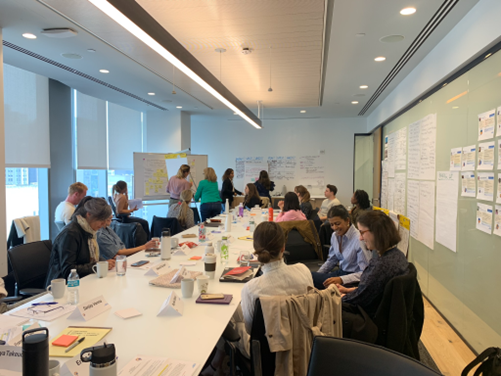
Equally effective for making a room your own are the “group memory” records and visuals created by participants themselves. Methods that generate a combination of posted notes and connecting graphics, for example, can result in “gallery walls” that capture positive outputs and reinforce a sense of progress and momentum.

When results from working groups are posted in a plenary room, facilitators and participants can refer back to them and build on them in a powerful incremental way.

When wall space is limited, use windows!

Create a bio wall. An important wall visual to help people get to know each other better and connect informally is a “bio wall”. A half-page or one-page biographical profile of each participant works beautifully. Photos and the bio information can be collected ahead of time and the profiles printed, or they can be prepared as part of an event opening. Create and use a standard template to make it easy and quick for people to complete. Combine factual information with questions that aren’t about work: favorite music (add to the playlist), a pet peeve, what the person would be doing if they weren’t in their current job.

Use graphic recording. Graphic recording techniques add a lively human tone to a room, especially when they are changed regularly and convey key information about the process.

Use wall graphics to give information and get inputs from participants. They serve a range of purposes, displaying information and acting as interactive feedback mechanisms that support full engagement. Typical examples include the process norms generated by the group, collaborative music playlists, participant input boards, and daily parking lot lists for review. All of these need space!

Some natural light in a room is a priority. Make sure that there’s also enough wall space to use for a range of purposes that support a strong interactive process.
Always check with a vendor or venue manager about whether you can post things on walls, and the requirements. For some events, the facilitation team thought we had enough wall space because the room looked perfect, but when we arrived at the venue, we learned that nothing could be posted on that particular wall covering. Few places have enough rolling boards or flip chart stands to create an interactive wall or a gallery display wall.
Double-sided tape, blue tac, pins, thumb tacks: make sure you confirm what you can use to fix graphics and visuals to walls before you purchase supplies.
Try to ensure flexible seating that supports purpose
Some venues have fixed seating which depending on the arrangement can undermine a collaborative process. If you can, avoid seating arrangements that don’t offer flexible opportunity to rearrange seats.
“Pods” are preferable, table seating with round tables at which people can have table conversations, a key way to engage everyone. When energy in a group is slumping, a quick decision to invite participants to have a 10 minute table conversation can significantly raise the energy levels.
Where a theatre style prevents full table conversations, consider using “buzz groups” of 3 people or pairs, including for example in a walking conversation if the venue permits it. Energy benefits are matched by cognitive benefits. Plan to build movement into the design flow.
A theatre-style arrangement is fine for certain types of events, for example town-hall meetings and briefings, but typically not effective for interactive participatory processes or workshops.
When one long rectangular table is the only option, it means people at one end are challenged to interact with people at the other end. That single long table can create a boardroom dynamic that inhibits full and open exchange.
In a narrow room, it can further limit opportunities for quick creative brainstorming and recombinant pairs, groups of three and small groups.
In conclusion - key questions to ask
Often a meeting or process design has to accommodate itself to limitations of venue or room availability. In an ideal world, the reverse would be the case. Particularly for learning events and intense exchanges, look for rooms and venues that are designed to support your purpose.
One of the best places I’ve ever facilitated was in a training centre designed for the UniManagement Bank in Turin, Italy. An excellent high-ceiling plenary room, readily accessible break out areas, easily arranged chairs and removable tables, a kitchen for culinary team building, a library for quiet times, a separate area for breaks and lunches, and a full business centre. Ah, what a pleasure it was to facilitate there! Few venues can meet that unique design standard. It’s always important to invest careful time exploring and selecting the best possible available venue.
Ask key questions before you confirm a venue or rooms. You’ll still have to adapt to what’s available, but you can minimize need to compromise your design and work around physical constraints.
What is the total area available in the proposed room? How is it laid out?
Does the room have windows, natural light? Avoid rooms without windows if you can!
How much space is available for each expected participant? For interactive sessions and workshops, 25-30+ square feet are recommended – 2.3 to 2.8 square metres. A space calculator tool can help with early planning, available on-line.
What are the options for room layout and seating? Do these match your purpose and objectives? How much time do the venue support people need to rearrange the seating?
Does the room accommodate additional tables for a) resources and materials display, b) a charging station, c) facilitation supplies? Is a separate area available for breaks?
What facilities are there for hanging coats? Especially important in cold climates in winter!
How much wall space is available to post event-specific materials?
Are there restrictions on how materials can be posted to the walls? Does the venue provide required adhesives or pins, or are you responsible for purchasing them?
Is the venue accessible to people with disabilities, including those using wheelchairs? Can tables be far enough apart that people in wheelchairs can easily move through the group? What limitations present and what work arounds are possible?
Who is your dedicated, on-site contact for immediate issues during the event? Sometimes you won’t have imagined what can go wrong and you’ll need to be able to contact someone for immediate attention when you have a problem. Have a back-up!
Explore INSIGHTS at facilitateit.ca for other tips from experience. (link).